Triangle wave
 A bandlimited triangle wave[1] pictured in the time domain (top) and frequency domain (bottom). The fundamental is at 220 Hz (A3). Image: source and license | |
| General information | |
|---|---|
| General definition |  |
| Fields of application | Electronics, synthesizers |
| Domain, codomain and image | |
| Domain |  |
| Codomain |  |
| Basic features | |
| Parity | Odd |
| Period | 1 |
| Specific features | |
| Root |  |
| Derivative | Square wave |
| Fourier series |  |
A triangular wave or triangle wave is a non-sinusoidal waveform named for its triangular shape. It is a periodic, piecewise linear, continuous real function.
Like a square wave, the triangle wave contains only odd harmonics. However, the higher harmonics roll off much faster than in a square wave (proportional to the inverse square of the harmonic number as opposed to just the inverse).
Definitions#edit

Definition#edit
A triangle wave of period p that spans the range [0, 1] is defined as 

For a triangle wave spanning the range [−1, 1] the expression becomes


A more general equation for a triangle wave with amplitude 


For example, for a triangle wave with amplitude 5 and period 4:

A phase shift can be obtained by altering the value of the 

As this only uses the modulo operation and absolute value, it can be used to simply implement a triangle wave on hardware electronics.
Note that in many programming languages, the % operator is a remainder operator (with result the same sign as the dividend), not a modulo operator; the modulo operation can be obtained by using ((x % p) + p) % p in place of x % p. In e.g. JavaScript, this results in an equation of the form 4*a/p * Math.abs((((x - p/4) % p) + p) % p - p/2) - a.
Relation to the square wave#edit
The triangle wave can also be expressed as the integral of the square wave:

Expression in trigonometric functions#edit
A triangle wave with period p and amplitude a can be expressed in terms of sine and arcsine (whose value ranges from −π/2 to π/2): 


Expressed as alternating linear functions#edit
Another definition of the triangle wave, with range from −1 to 1 and period p, is

Harmonics#edit
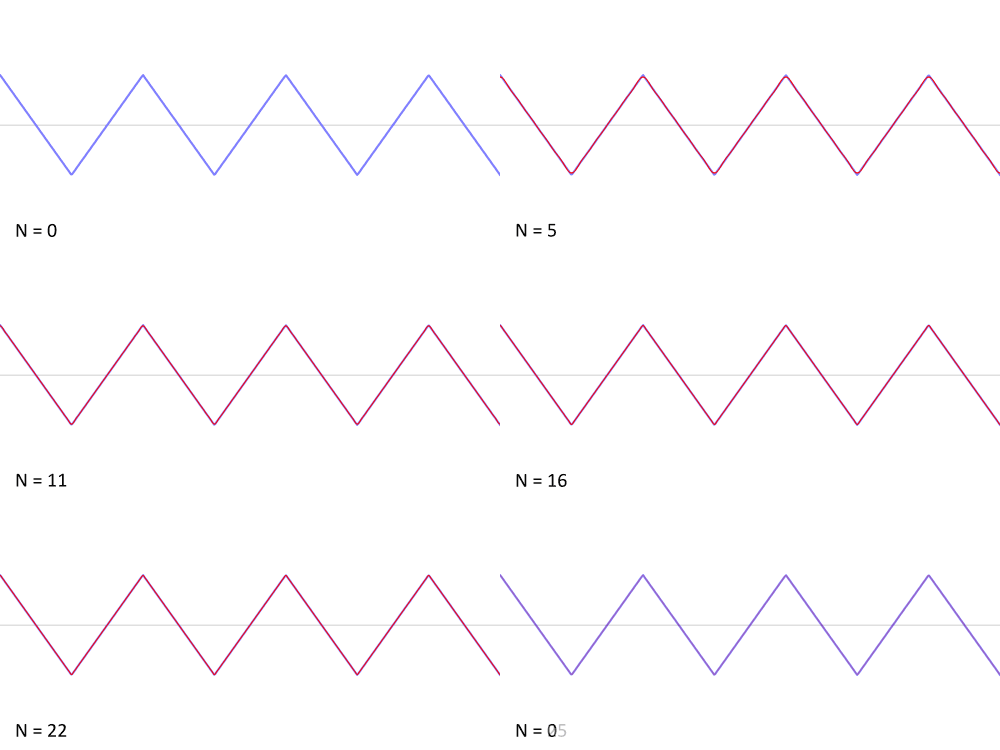
It is possible to approximate a triangle wave with additive synthesis by summing odd harmonics of the fundamental while multiplying every odd harmonic by −1 (or, equivalently, changing its phase by π) and dividing the amplitude of the harmonics by the square of their mode number, n (which is equivalent to their relative frequency to the fundamental).
The above can be summarised mathematically as follows: 


This infinite Fourier series converges quickly to the triangle wave as N tends to infinity, as shown in the animation.
Arc length#edit
The arc length per period for a triangle wave, denoted by s, is given in terms of the amplitude a and period length p by


See also#edit
References#edit
- ^ Kraft, Sebastian; Zölzer, Udo (5 September 2017). "LP-BLIT: Bandlimited Impulse Train Synthesis of Lowpass-filtered Waveforms". Proceedings of the 20th International Conference on Digital Audio Effects (DAFx-17). 20th International Conference on Digital Audio Effects (DAFx-17). Edinburgh. pp. 255–259.
This article is mirrored from “Triangle wave” on English Wikipedia, revision 1360453822, written by Wikipedia's contributors and licensed CC BY-SA 4.0. Editing it here creates a Quire copy with its own history.
Synced with Wikipedia revision 1360453822 · just now