Sublinear function
In linear algebra, a sublinear function (or functional as is more often used in functional analysis), also called a quasi-seminorm, on a vector space is a real-valued function with some of the properties of a seminorm. Unlike seminorms, a sublinear function does not have to be nonnegative-valued and also does not have to be absolutely homogeneous. Seminorms are themselves abstractions of the more well known notion of norms, where a seminorm has all the defining properties of a norm except that it is not required to map non-zero vectors to non-zero values.
In functional analysis the name Banach functional is sometimes used, reflecting that they are most commonly used when applying a general formulation of the Hahn–Banach theorem. The notion of a sublinear function was introduced by Stefan Banach when he proved the Hahn-Banach theorem.[1]
There is also a different notion in computer science, described below, that also goes by the name "sublinear function."
Definitions#edit
Let be a vector space over a field
where
is either the real numbers
or complex numbers
A function
is called 'sublinear' if it has these two properties:[1]
- Positive homogeneity,[2] that is
, for all
and
.
- Subadditivity,[2] that is
for
A function is called positive[3] or nonnegative if
for all
although some authors[4] define positive to instead mean that
whenever
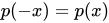
these definitions are not equivalent. It is a symmetric function if
for all
Every subadditive symmetric function is necessarily nonnegative.[5] A sublinear function on a real vector space is symmetric if and only if it is a seminorm. A sublinear function on a real or complex vector space is a seminorm if and only if it is a balanced function or equivalently, if and only if
for every unit length scalar
and
The set of all sublinear functions on denoted by
can be partially ordered by declaring
if and only if
for all
A sublinear function is called 'minimal' if it is a minimal element of
under this order. A sublinear function is minimal if and only if it is a real linear functional.[1]
Examples and sufficient conditions#edit
Every norm, seminorm, and real linear functional is a sublinear function. The identity function on is an example of a sublinear function (in fact, it is even a linear functional) that is neither positive nor a seminorm; the same is true of this map's negation
[6] More generally, for any real
the map
is a sublinear function on and moreover, every sublinear function
is of this form; specifically, if
and
then
and
If and
are sublinear functions on a real vector space
then so is the map
More generally, if
is any non-empty collection of sublinear functionals on a real vector space
and if for all
then
is a sublinear functional on
[6]
A function which is subadditive, convex, and satisfies
is also positively homogeneous (the latter condition
is necessary as the example of
on
shows). If
is positively homogeneous, it is convex if and only if it is subadditive. Therefore, assuming
, any two properties among subadditivity, convexity, and positive homogeneity implies the third.
Properties#edit
Every sublinear function is a convex function: For
If is a sublinear function on a vector space
then[7][3]
for every
which implies that at least one of
and
must be nonnegative; that is, for every
[3]
Moreover, when
is a sublinear function on a real vector space then the map
defined by
is a seminorm.[3]
Subadditivity of guarantees that for all vectors
[1][8]
so if
is also symmetric then the reverse triangle inequality will hold for all vectors
Defining then subadditivity also guarantees that for all
the value of
on the set
is constant and equal to
[9] In particular, if
is a vector subspace of
then
and the assignment
which will be denoted by
is a well-defined real-valued sublinear function on the quotient space
that satisfies
If
is a seminorm then
is just the usual canonical norm on the quotient space
Pryce's sublinearity lemma[2]—Suppose is a sublinear functional on a vector space
and that
is a non-empty convex subset. If
is a vector and
are positive real numbers such that
then for every positive real
there exists some
such that
Adding to both sides of the hypothesis
(where
) and combining that with the conclusion gives
which yields many more inequalities, including, for instance,
in which an expression on one side of a strict inequality
can be obtained from the other by replacing the symbol
with
(or vice versa) and moving the closing parenthesis to the right (or left) of an adjacent summand (all other symbols remain fixed and unchanged).
Associated seminorm#edit
If is a real-valued sublinear function on a real vector space
(or if
is complex, then when it is considered as a real vector space) then the map
defines a seminorm on the real vector space
called the seminorm associated with
[3] A sublinear function
on a real or complex vector space is a symmetric function if and only if
where
as before.
More generally, if is a real-valued sublinear function on a (real or complex) vector space
then
will define a seminorm on
if this supremum is always a real number (that is, never equal to
).
Relation to linear functionals#edit
If is a sublinear function on a real vector space
then the following are equivalent:[1]
is a linear functional.
- for every
- for every
is a minimal sublinear function.
If is a sublinear function on a real vector space
then there exists a linear functional
on
such that
[1]
If is a real vector space,
is a linear functional on
and
is a positive sublinear function on
then
on
if and only if
[1]
Dominating a linear functional#edit
A real-valued function defined on a subset of a real or complex vector space
is said to be dominated by a sublinear function
if
for every
that belongs to the domain of
If
is a real linear functional on
then[10][1]
is dominated by
(that is,
) if and only if
Moreover, if
is a seminorm or some other symmetric map (which by definition means that
holds for all
) then
if and only if
Theorem[1]—If be a sublinear function on a real vector space
and if
then there exists a linear functional
on
that is dominated by
(that is,
) and satisfies
Moreover, if
is a topological vector space and
is continuous at the origin then
is continuous.
Continuity#edit
Theorem[11]—Suppose is a subadditive function (that is,
for all
). Then
is continuous at the origin if and only if
is uniformly continuous on
If
satisfies
then
is continuous if and only if its absolute value
is continuous. If
is non-negative then
is continuous if and only if
is open in
Suppose is a topological vector space (TVS) over the real or complex numbers and
is a sublinear function on
Then the following are equivalent:[11]
is continuous;
is continuous at 0;
is uniformly continuous on
;
and if is positive then this list may be extended to include:
is open in
If is a real TVS,
is a linear functional on
and
is a continuous sublinear function on
then
on
implies that
is continuous.[11]
Relation to Minkowski functions and open convex sets#edit
Theorem[11]—If is a convex open neighborhood of the origin in a topological vector space
then the Minkowski functional of
is a continuous non-negative sublinear function on
such that
if in addition
is a balanced set then
is a seminorm on
Relation to open convex sets#edit
Theorem[11]—Suppose that is a topological vector space (not necessarily locally convex or Hausdorff) over the real or complex numbers. Then the open convex subsets of
are exactly those that are of the form
for some
and some positive continuous sublinear function
on
Proof
Let be an open convex subset of
If
then let
and otherwise let
be arbitrary. Let
be the Minkowski functional of
which is a continuous sublinear function on
since
is convex, absorbing, and open (
however is not necessarily a seminorm since
was not assumed to be balanced). From
it follows that
It will be shown that
which will complete the proof. One of the known properties of Minkowski functionals guarantees
where
since
is convex and contains the origin. Thus
as desired.
Operators#edit
The concept can be extended to operators that are homogeneous and subadditive. This requires only that the codomain be, say, an ordered vector space to make sense of the conditions.
Computer science definition#edit
In computer science, a function is called sublinear if
or
in asymptotic notation (notice the small
). Formally,
if and only if, for any given
there exists an
such that
for
[12] That is,
grows slower than any linear function. The two meanings should not be confused: while a Banach functional is convex, almost the opposite is true for functions of sublinear growth: every function
can be upper-bounded by a concave function of sublinear growth.[13]
See also#edit
- Asymmetric norm – Generalization of the concept of a norm
- Auxiliary normed space
- Hahn-Banach theorem – Theorem on extension of bounded linear functionals
- Linear functional – Linear map from a vector space to its field of scalars
- Minkowski functional – Function made from a set
- Norm (mathematics) – Length in a vector space
- Seminorm – Mathematical function
- Superadditivity – Property of a function
Notes#edit
Proofs
- ^ a b c d e f g h i Narici & Beckenstein 2011, pp. 177–220.
- ^ a b c Schechter 1996, pp. 313–315.
- ^ a b c d e Narici & Beckenstein 2011, pp. 120–121.
- ^ Kubrusly 2011, p. 200.
- ^ Let
The triangle inequality and symmetry imply
Substituting
for
and then subtracting
from both sides proves that
Thus
which implies
- ^ a b Narici & Beckenstein 2011, pp. 177–221.
- ^ If
and
then nonnegative homogeneity implies that
Consequently,
which is only possible if
- ^
which happens if and only if
Substituting
and gives
which implies
(positive homogeneity is not needed; the triangle inequality suffices).
- ^ Let
and
It remains to show that
The triangle inequality implies
Since
as desired.
- ^ Rudin 1991, pp. 56–62.
- ^ a b c d e Narici & Beckenstein 2011, pp. 192–193.
- ^ Thomas H. Cormen, Charles E. Leiserson, Ronald L. Rivest, and Clifford Stein (2001) [1990]. "3.1". Introduction to Algorithms (2nd ed.). MIT Press and McGraw-Hill. pp. 47–48. ISBN 0-262-03293-7.
- ^ Ceccherini-Silberstein, Tullio; Salvatori, Maura; Sava-Huss, Ecaterina (2017-06-29). Groups, graphs, and random walks. Cambridge. Lemma 5.17. ISBN 9781316604403. OCLC 948670194.
Bibliography#edit
- Kubrusly, Carlos S. (2011). The Elements of Operator Theory (Second ed.). Boston: Birkhäuser. ISBN 978-0-8176-4998-2. OCLC 710154895.
- Rudin, Walter (1991). Functional Analysis. International Series in Pure and Applied Mathematics. Vol. 8 (Second ed.). New York, NY: McGraw-Hill Science/Engineering/Math. ISBN 978-0-07-054236-5. OCLC 21163277.
- Narici, Lawrence; Beckenstein, Edward (2011). Topological Vector Spaces. Pure and applied mathematics (Second ed.). Boca Raton, FL: CRC Press. ISBN 978-1584888666. OCLC 144216834.
- Schaefer, Helmut H.; Wolff, Manfred P. (1999). Topological Vector Spaces. GTM. Vol. 8 (Second ed.). New York, NY: Springer New York Imprint Springer. ISBN 978-1-4612-7155-0. OCLC 840278135.
- Schechter, Eric (1996). Handbook of Analysis and Its Foundations. San Diego, CA: Academic Press. ISBN 978-0-12-622760-4. OCLC 175294365.
- Trèves, François (2006) [1967]. Topological Vector Spaces, Distributions and Kernels. Mineola, N.Y.: Dover Publications. ISBN 978-0-486-45352-1. OCLC 853623322.
This article is mirrored from “Sublinear function” on English Wikipedia, revision 1374573005, written by Wikipedia's contributors and licensed CC BY-SA 4.0. Editing it here creates a Quire copy with its own history.
Synced with Wikipedia revision 1374573005 · just now