K-function
In mathematics, the K-function, typically denoted K(z), is a generalization of the hyperfactorial to complex numbers, similar to the generalization of the factorial to the gamma function.
Definition#edit
There are multiple equivalent definitions of the K-function.
The direct definition:

Definition via

where ζ′(z) denotes the derivative of the Riemann zeta function, ζ(a,z) denotes the Hurwitz zeta function and

Definition via polygamma function:[1]

Definition via balanced generalization of the polygamma function:[2]

where A is the Glaisher constant.
It can be defined via unique characterization, similar to how the gamma function can be uniquely characterized by the Bohr-Mollerup Theorem:
Let
be a solution to the functional equation
, such that there exists some
, such that given any distinct
, the divided difference
. Such functions are precisely
, where
is an arbitrary constant.[3]
Properties#edit
For α > 0:

Proof
Let

Differentiating this identity now with respect to α yields:

Applying the logarithm rule we get
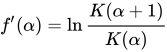
By the definition of the K-function we write

And so

Setting α = 0 we have

Functional equations#edit
The K-function is closely related to the gamma function and the Barnes G-function. For all complex 

Multiplication formula#edit
Similar to the multiplication formula for the gamma function:

there exists a multiplication formula for the K-Function involving Glaisher's constant:[4]

Integer values#edit
For all non-negative integers,

The first values are
- 1, 4, 108, 27648, 86400000, 4031078400000, 3319766398771200000, ... (sequence A002109 in the OEIS).
References#edit
- ^ Adamchik, Victor S. (1998), "PolyGamma Functions of Negative Order", Journal of Computational and Applied Mathematics, 100 (2): 191–199, doi:10.1016/S0377-0427(98)00192-7, archived from the original on 2016-03-03
- ^ Espinosa, Olivier; Moll, Victor Hugo (2004) [April 2004], "A Generalized polygamma function" (PDF), Integral Transforms and Special Functions, 15 (2): 101–115, doi:10.1080/10652460310001600573, archived (PDF) from the original on 2023-05-14
- ^ Marichal, Jean-Luc; Zenaïdi, Naïm (2024). "A Generalization of Bohr-Mollerup's Theorem for Higher Order Convex Functions: a Tutorial" (PDF). Bitstream. 98 (2): 455–481. arXiv:2207.12694. doi:10.1007/s00010-023-00968-9. Archived (PDF) from the original on 2023-04-05.
- ^ Sondow, Jonathan; Hadjicostas, Petros (2006-10-16). "The generalized-Euler-constant function γ(z) and a generalization of Somos's quadratic recurrence constant". Journal of Mathematical Analysis and Applications. 332: 292–314. arXiv:math/0610499. doi:10.1016/j.jmaa.2006.09.081.
External links#edit
This article is mirrored from “K-function” on English Wikipedia, revision 1327744035, written by Wikipedia's contributors and licensed CC BY-SA 4.0. Editing it here creates a Quire copy with its own history.
Synced with Wikipedia revision 1327744035 · just now