Quire

Inverse function rule

From Quire, the open reference·Formula for the derivative of an inverse function·3 min read
The thick blue curve and the thick red curve are inverse to each other. A thin curve is the derivative of the same colored thick curve. Inverse function rule:Example for arbitrary :
The thick blue curve and the thick red curve are inverse to each other. A thin curve is the derivative of the same colored thick curve. Inverse function rule:
{\displaystyle {\color {CornflowerBlue}{f'(x)={\frac {1}\color {Salmon}{\left[f^{-1}\right]'({\color {Blue}{f(x))

Example for arbitrary {\displaystyle x_{0}\approx 5.8}:
{\displaystyle {\color {CornflowerBlue}{f'(x_{0})={\frac {1}{4
{\displaystyle {\color {Salmon}{\left[f^{-1}\right]'({\color {Blue}{f(x_{0}))=4~} Image: source and license

In calculus, the inverse function rule is a formula that expresses the derivative of the inverse of a bijective and differentiable function f in terms of the derivative of f. More precisely, if the inverse of {\displaystyle f} is denoted as {\displaystyle f^{-1, where {\displaystyle f^{-1}(y)=x} if and only if {\displaystyle f(x)=y}, then the inverse function rule is, in Lagrange's notation,

{\displaystyle \left[f^{-1}\right]'(y)={\frac {1}{f'\left(f^{-1}(y)\right).}

This formula holds in general whenever {\displaystyle f} is continuous and injective on an interval I, with {\displaystyle f} being differentiable at {\displaystyle f^{-1}(y)}({\displaystyle \in I}) and where{\displaystyle f'(f^{-1}(y))\neq 0}. The same formula is also equivalent to the expression

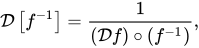
{\displaystyle {\mathcal {D\left[f^{-1}\right]={\frac {1}{({\mathcal {Df)\circ \left(f^{-1}\right),}

where {\displaystyle {\mathcal {D denotes the unary derivative operator (on the space of functions) and {\displaystyle \circ } denotes function composition.

Geometrically, a function and inverse function have graphs that are reflections, in the line {\displaystyle y=x}. This reflection operation turns the gradient of any line into its reciprocal.[1]

Assuming that {\displaystyle f} has an inverse in a neighbourhood of {\displaystyle x} and that its derivative at that point is non-zero, its inverse is guaranteed to be differentiable at {\displaystyle x} and have a derivative given by the above formula.

The inverse function rule may also be expressed in Leibniz's notation. As that notation suggests,

{\displaystyle {\frac {dx}{dy\,{\frac {dy}{dx=1.}

This relation is obtained by differentiating the equation {\displaystyle f^{-1}(y)=x} in terms of x and applying the chain rule, yielding that:

{\displaystyle {\frac {dx}{dy\,{\frac {dy}{dx={\frac {dx}{dx

considering that the derivative of x with respect to x is 1.

Derivation#edit

Let {\displaystyle f} be an invertible (bijective) function, let {\displaystyle x} be in the domain of {\displaystyle f}, and let {\displaystyle y=f(x).} Let {\displaystyle g=f^{-1}.} So, {\displaystyle f(g(y))=y.} Differentiating this equation with respect to ⁠{\displaystyle y}⁠, and using the chain rule, one gets

{\displaystyle f'(g(y))\cdot g'(y)=1.}

That is,

{\displaystyle g'(y)={\frac {1}{f'(g(y))

or

{\displaystyle \left[f^{-1}\right]^{\prime }(y)={\frac {1}{f^{\prime }(f^{-1}(y)).}

Examples#edit

  • {\displaystyle y=x^{2 (for positive x) has inverse {\displaystyle x={\sqrt {y.
{\displaystyle {\frac {dy}{dx=2x{\mbox{ {\mbox{ {\mbox{ {\mbox{ ;{\mbox{ {\mbox{ {\mbox{ {\mbox{ {\frac {dx}{dy={\frac {1}{2{\sqrt {y&#61
{\displaystyle {\frac {dy}{dx\,{\frac {dx}{dy=2x\cdot {\frac {1}{2x=1.}

At {\displaystyle x=0}, however, there is a problem: the graph of the square root function becomes vertical, corresponding to a horizontal tangent for the square function.

  • {\displaystyle y=e^{x (for real x) has inverse {\displaystyle x=\ln {y (for positive {\displaystyle y})
{\displaystyle {\frac {dy}{dx=e^{x}{\mbox{ {\mbox{ {\mbox{ {\mbox{ ;{\mbox{ {\mbox{ {\mbox{ {\mbox{ {\frac {dx}{dy={\frac {1}{y=e^&#1
{\displaystyle {\frac {dy}{dx\,{\frac {dx}{dy=e^{x}e^{-x}=1.}

Additional properties#edit

{\displaystyle {f^{-1(y)=\int {\frac {1}{f'({f^{-1(y))\,{dy}+C.}
This is only useful if the integral exists. In particular we need {\displaystyle f'(x)} to be non-zero across the range of integration.
It follows that a function that has a continuous derivative has an inverse in a neighbourhood of every point where the derivative is non-zero. This need not be true if the derivative is not continuous.
  • Another very interesting and useful property is the following:
{\displaystyle \int f^{-1}(y)\,{dy}=yf^{-1}(y)-F(f^{-1}(y))+C}
where {\displaystyle F} denotes the antiderivative of {\displaystyle f}.
  • The inverse of the derivative of f(x) is also of interest, as it is used in showing the convexity of the Legendre transform.

Let {\displaystyle z=f'(x)} then we have, assuming {\displaystyle f''(x)\neq 0}:{\displaystyle {\frac {d}{dz\left[f'\right]^{-1}(z)={\frac {1}{f''(x)This can be shown using the previous notation {\displaystyle y=f(x)}. Then we have:

{\displaystyle f'(x)={\frac {dy}{dx={\frac {dy}{dz{\frac {dz}{dx={\frac {dy}{dzf''(x)\Rightarrow {\frac {dy}{dz={\frac {f'(x)}{f''(x)Therefore:
{\displaystyle {\frac {d}{dz[f']^{-1}(z)={\frac {dx}{dz={\frac {dy}{dz{\frac {dx}{dy={\frac {f'(x)}{f''(x){\frac {1}{f'(x)={\frac &#

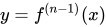
By induction, we can generalize this result for any integer {\displaystyle n\geq 1}, with {\displaystyle z=f^{(n)}(x)}, the nth derivative of f(x), and {\displaystyle y=f^{(n-1)}(x)}, assuming {\displaystyle f^{(i)}(x)\neq 0{\text{ for 0<i\leq n+1}:

{\displaystyle {\frac {d}{dz\left[f^{(n)}\right]^{-1}(z)={\frac {1}{f^{(n+1)}(x)

Higher order derivatives#edit

The chain rule given above is obtained by differentiating the identity {\displaystyle f^{-1}(y)=x} with respect to y, where {\displaystyle y=f(x)}. One can continue the same process for higher derivatives. Differentiating the identity twice with respect to x, one obtains

{\displaystyle {\frac {d^{2}y}{dx^{2\,{\frac {dx}{dy+{\frac {d}{dx\left({\frac {dx}{dy\right)\,\left({\frac {dy}{dx\right)=0,}

that is simplified further by the chain rule as

{\displaystyle {\frac {d^{2}y}{dx^{2\,{\frac {dx}{dy+{\frac {d^{2}x}{dy^{2\,\left({\frac {dy}{dx\right)^{2}=0.}

Replacing the first derivative, using the identity obtained earlier, we get

{\displaystyle {\frac {d^{2}y}{dx^{2=-{\frac {d^{2}x}{dy^{2\,\left({\frac {dy}{dx\right)^{3

which implies

{\displaystyle {\frac {d^{2}x}{dy^{2=-{\frac {d^{2}y/dx^{2{\left(dy/dx\right)^{3.}

Similarly for the third derivative we have

{\displaystyle {\frac {d^{3}y}{dx^{3=-{\frac {d^{3}x}{dy^{3\,\left({\frac {dy}{dx\right)^{4}-3{\frac {d^{2}x}{dy^{2\,{\frac {d^{2}y&#125

Using the formula for the second derivative, we get

{\displaystyle {\frac {d^{3}y}{dx^{3=-{\frac {d^{3}x}{dy^{3\,\left({\frac {dy}{dx\right)^{4}+3\left({\frac {d^{2}y}{dx^{2\right)^{2}\,\left({

which implies

{\displaystyle {\frac {d^{3}x}{dy^{3=-{\frac {d^{3}y/dx^{3{\left(dy/dx\right)^{4+3{\frac {\left(d^{2}y/dx^{2}\right)^{2{\left(dy/dx\right)^{5.}

In general, higher order derivatives of an inverse function can be expressed with Faà di Bruno's formula. Alternatively, the nth derivative can be written succinctly as an application of a differential operator:

{\displaystyle \left[f^{-1}\right]^{(n)}(y)=\left.\left[\left({\frac {1}{f'(t){\frac {d}{dt\right)^{n}t\right]\right|_{t=f^{-1}(y)}.}

In Lagrange's notation, the second and third derivatives from the examples above can be found as applying the operator and substituting {\displaystyle t=f^{-1}(y)} after:

{\displaystyle \left[f^{-1}\right]''(y)=\left.\left[{\frac {1}{f'(t){\frac {d}{dt\left({\frac {1}{f'(t){\frac {d}{dtt\right)\right]\right|_{t=f^{-1}(y)}
{\displaystyle \left[f^{-1}\right]'''(y)=\left.\left[{\frac {1}{f'(t){\frac {d}{dt\left({\frac {1}{f'(t){\frac {d}{dt\left({\frac {1}{f'(t){\frac {d}&

One can also derive the nth-integration of inverse function with base-point a using Cauchy formula for repeated integration whenever {\displaystyle f(f^{-1}(y))=y}:

{\displaystyle \left[f^{-1}\right]^{(-n)}(y)={\frac {1}{n!\left(f^{-1}(a)(y-a)^{n}+\int _{f^{-1}(a)}^{f^{-1}(y)}\left(y-f(u)\right)^{n}\,du\right).}

Example#edit

  • {\displaystyle y=e^{x has the inverse {\displaystyle x=\ln y}. Using the formula for the second derivative of the inverse function,
{\displaystyle {\frac {dy}{dx={\frac {d^{2}y}{dx^{2=e^{x}=y{\mbox{ {\mbox{ {\mbox{ {\mbox{ ;{\mbox{ {\mbox{ {\mbox{ {\mbox{ \left({\f

so that

{\displaystyle {\frac {d^{2}x}{dy^{2\,\cdot \,y^{3}+y=0{\mbox{ {\mbox{ {\mbox{ {\mbox{ ;{\mbox{ {\mbox{ {\mbox{ {\mbox{ {\frac {d^{2}x}{

which agrees with the direct calculation.

See also#edit

References#edit

Citations#edit

  1. ^ "Derivatives of Inverse Functions". oregonstate.edu. Archived from the original on 2021-04-10. Retrieved 2019-07-26.

Sources#edit

  • Marsden, Jerrold E.; Weinstein, Alan (1981). "Chapter 8: Inverse Functions and the Chain Rule". Calculus unlimited (PDF). Menlo Park, Calif.: Benjamin/Cummings Pub. Co. ISBN 0-8053-6932-5.

This article is mirrored from “Inverse function rule” on English Wikipedia, revision 1369278829, written by Wikipedia's contributors and licensed CC BY-SA 4.0. Editing it here creates a Quire copy with its own history.

Synced with Wikipedia revision 1369278829 · just now