Flat function

In real analysis, a real function is defined to be flat at a point in its domain if all its derivatives or partial derivatives exist at that point and equal .
A real function is locally constant (that is, constant in at least one neighbourhood) of a point in the interior of its domain if and only if the function is flat and analytic at that point.
An example of a function that is flat only at an isolated point is such that
and that for all
,
implies
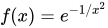
; the function
is flat only at
.
Since is not analytic at
, the extension of
to
is not holomorphic at
, since for complex functions, holomorphicity at a point implies analyticity at that point.
Examples of construction of non-trivial flat functions#edit
By a non-trivial flat function, what is meant is a function that, at least at one point in the interior of its domain, is flat but not locally constant.
Construction of univariate flat functions#edit
Let be a positive real number and let
(where
is a neighbourhood of a point
) be such that
and that for all
,
implies
Then is flat at
.
Construction of multivariate flat functions#edit
Let be flat at
, and let
(where
,
is an
-dimensional real coordinate vector, and
is a neighbourhood of
) be such that for all
,
, where for all
,
denotes the Euclidean norm of
.
Then is flat at
.
A necessary condition for flatness and local non-constancy#edit
Let for some
and let
be flat at a point
in the interior of
. Also let it be the case that for every neighbourhood
of
, there exists an
such that
, that is, that
is not locally constant at
. Then
is non-analytic at
.
Proof#edit
Assume the contrary, that is, that is analytic at
. Since
is flat at
, the Taylor series of
at
is constant and equal to
. Since it is assumed that
is analytic at
, then there exists a neighbourhood
of
such that for all
,
. This contradicts that for every neighbourhood
of
, there exists an
such that
. Hence, by contradiction,
is non-analytic at
.
A sufficient condition for flatness#edit
Let for some
and let
be infinitely differentiable at a point
in the interior of
. Also let it be the case that for every neighbourhood
of
, there exists an
such that
is flat at
. Then
is flat at
.
Proof#edit
Assume the contrary, that is, that is not flat at
. Then there exists a
such that a
-th partial derivative of
(call it
) is non-zero at
, that is,
for some
such that
. Since
is infinitely differentiable at
, then
is continuous at
. Since
, then
. Then there exists a neighbourhood
of
such that for all
,
, which means
, or, in other words,
lies in the open interval
. Since
,
, so
, which means that there exists a
such that a
-th partial derivative of
is non-zero at
. This contradicts that
is flat at at least one point in every neighbourhood of
. Hence, by contradiction,
is flat at
.
The above results can be used to show that a bump function is flat and non-analytic at each boundary point of the closure of its support.
Flatness of smooth interpolations#edit
Let and
be such that
.
Let be an interval with non-empty interior, with supremum
, and containing
; and let
be an interval with non-empty interior, with infimum
, and containing
.
In the following, continuity, one-sided continuity, one-sided limits, differentiability and smoothness of a real coordinate vector-valued function are respectively given by continuity, one-sided continuity, one-sided limits, differentiability and smoothness of the function in each coordinate.
Let . Let
be continuously differentiable at every point in the interior of
, left-continuous at
and have the left-hand limit of its derivatives of all orders be finite at
; also let
for all
. Let
be continuously differentiable at every point in the interior of
, right-continuous at
and have the right-hand limit of its derivatives of all orders be finite at
; also let
for all
.
Let curves and
be the images of the domains of
and
, respectively. Both
and
inhabit
.
A smooth interpolation between and
, between the points
and
, is the image of the domain of a function
such that the left-hand limit of
at
is
, the right-hand limit of
at
is
, and for all
, the left-hand limit of the
-th derivative of
at
is equal to the right-hand limit of the
-th derivative of
at
, and the right-hand limit of the
-th derivative of
at
is equal to the left-hand limit of the
-th derivative of
at
. A smooth interpolation between
and
is defined to have
continuity (geometric continuity of all orders) with
and
.
Let be such that: for all
,
; for all
,
; and for all
,
.
If and
are straight line segments,
is necessarily flat at
and
. If
and
are non-collinear straight line segments, there necessarily exists a point in
at which
is non-analytic. If the end segments of the smooth interpolation are not straight-segment extensions of line segments
and
,
is necessarily non-analytic at
and
.
See also#edit
References#edit
This article is mirrored from “Flat function” on English Wikipedia, revision 1381438053, written by Wikipedia's contributors and licensed CC BY-SA 4.0. Editing it here creates a Quire copy with its own history.
Synced with Wikipedia revision 1381438053 · just now